
Wagner Manufacturing’s mark history spans decades of production in Sidney, Ohio, and understanding the general shape of that history — including one specific later tribute line that trips up newer collectors — matters for accurate dating.
Founding and Early Years
Wagner Manufacturing was founded in Sidney, Ohio in the 1890s, growing over the following decades into one of the two most significant names in American cast iron cookware alongside Griswold. Early Wagner marks generally reflected the company’s straightforward “Wagner Ware” branding alongside its Sidney, Ohio location.
General Mark Evolution
As with Griswold, Wagner’s marks changed across several design eras over the decades, moving through different lettering styles and layouts — and as with Griswold, pinning down exact year ranges for each specific variation is genuinely detailed collector-level work best confirmed against a dedicated Wagner reference guide rather than a general overview; see our Sidney -0- guide for one particularly well-documented mark era specifically.
Corporate History and the Griswold Connection
Wagner, like Griswold, went through ownership changes over the decades, and at a later point the two historic rivals ended up connected under shared corporate ownership, leading to some crossover in molds and branding in later production years; see our Griswold vs. Wagner guide for the fuller picture of how that shared history complicates dating pieces from that later period.
‘Wagner’s 1891 Original’: A Later Tribute Line
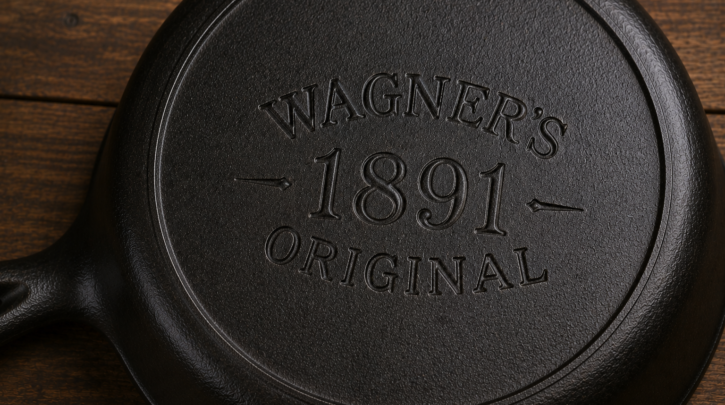
“Wagner’s 1891 Original” is a product line name referencing the company’s founding year, but it’s important not to confuse this branding with genuine 1890s production — it represents a later tribute or premium line named in honor of the company’s history rather than being itself an antique from that founding era. A piece carrying this specific branding should be dated according to when that tribute line was actually produced, not assumed to be a 19th-century original simply because of the year referenced in its name.
Why This Distinction Matters
Confusing a later tribute-line piece for genuine 1890s production is an easy, understandable mistake for a newer collector to make, and it’s exactly the kind of mix-up that can lead to significant overpayment if a seller — knowingly or not — represents a tribute piece as a true antique original.
Made in USA and Other Later Additions
Like many American manufacturers, later Wagner production often added explicit “Made in USA” text to markings, which can serve as one general dating clue alongside the overall logo style, though it should be cross-checked against other details rather than relied on alone.
Researching Further
Given how much fine-grained detail exists in Wagner’s mark history, a dedicated collector reference or active community remains the most reliable resource for confirming a specific mark variation’s approximate era with real confidence.
Stickers and Paper Labels
As with most vintage cast iron, Wagner pieces sometimes carried paper labels or stickers at the point of original sale, and these almost never survive decades of kitchen use and washing — their absence on an old piece is entirely normal rather than a sign of anything unusual.
Why Wagner’s History Rewards Patient Study
Wagner’s decades-long production run, its genuine competition with Griswold, and its later corporate entanglement with that same rival together make for a genuinely rich history to dig into — there’s real depth here for a collector willing to go beyond the surface-level “Wagner Ware” recognition most casual buyers stop at.
A Practical Dating Workflow for Wagner
- Identify the general “Wagner Ware” branding style present
- Check for the specific Sidney -0- treatment versus more generic later text
- Look for “Made in USA” or similar later additions
- Cross-reference against a dedicated Wagner mark resource for precise era confirmation
A Note on Patience With This Research
Wagner’s mark history rewards the same patient, incremental learning approach that pays off across every maker on this site — there’s no shortcut to genuine confidence beyond repeated exposure to verified pieces and a willingness to keep cross-referencing uncertain finds against reliable sources.
The payoff for that patience is a genuinely deep, rewarding corner of the broader vintage cast iron hobby.
Few names in the hobby reward that patience as consistently as Wagner does.