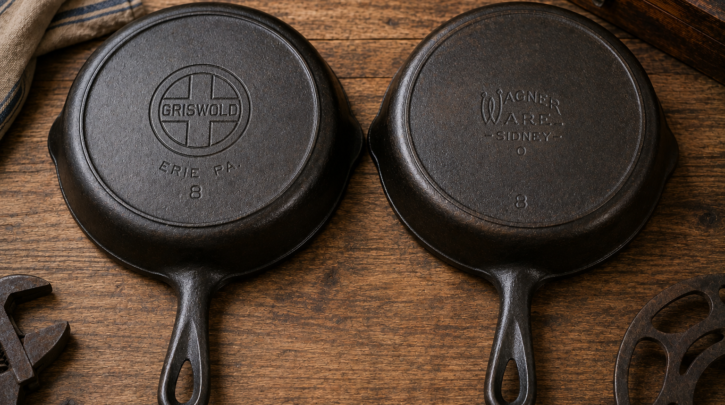

Griswold and Wagner were the two dominant American cast iron cookware makers of their era, genuine historic rivals whose later corporate history became tangled together in ways that still complicate collecting and dating both brands today.
Two Historic Rivals
Wagner Manufacturing, based in Sidney, Ohio, competed directly with Griswold for decades, producing a comparably broad range of skillets, Dutch ovens, and other cast iron cookware aimed at the same everyday American kitchen; see our Wagner identification guide for that brand’s own history and identification details.
Collector Recognition and Price
Griswold generally commands stronger collector recognition and higher average resale prices than comparable Wagner pieces, driven substantially by Griswold’s more extensively documented size and pattern numbering system and a correspondingly larger, more established collector community built around it.
Wagner as a Value Alternative
Many cooks and collectors consider Wagner pieces comparable to Griswold in genuine cooking quality, which makes Wagner a reasonable, often more affordable entry point for someone primarily interested in using vintage cast iron rather than chasing collector-premium rarity specifically.
Shared Corporate History
At a later point in both companies’ history, Griswold and Wagner ended up under common corporate ownership, which led to some crossover in molds and branding in later production years — a genuine complicating factor for collectors trying to draw clean, simple lines between the two brands in pieces from that later period specifically.
Why This Shared History Matters for Dating
Because of that later corporate overlap, a piece bearing one brand’s name doesn’t automatically rule out involvement from the other company’s tooling or ownership during that particular window — worth keeping in mind as one more reason precise late-era dating for both brands benefits from specialist reference resources rather than general assumptions.
Which Should You Collect?
For maximum collector recognition and resale value, Griswold remains the stronger choice, backed by the deeper reference material and larger community covered throughout this site’s Griswold guides. For a more affordable way into genuinely excellent vintage cooking cast iron, Wagner is a reasonable, often underrated alternative; see our Wagner identification guide for how to start identifying and collecting that brand specifically.
Many Collectors Pursue Both
Rather than choosing one brand exclusively, many serious collectors end up pursuing both Griswold and Wagner side by side, since the two brands’ history and even occasional physical overlap make them a genuinely natural pair to collect and study together rather than entirely separate pursuits.
Cooking Performance Is Genuinely Comparable
Setting collector value aside entirely, both brands produced cookware built to the same basic standard of well-seasoned, durable cast iron that performs excellently in daily use — the practical cooking difference between a good Griswold skillet and a good Wagner skillet of comparable size and era is genuinely minor, which is exactly why so many everyday cooks are happy to use either brand interchangeably in their kitchen.
A Simple Way to Decide
If collector recognition, resale value, and the deepest reference material available matter most, Griswold is the more established choice. If getting excellent vintage cookware into daily rotation at a lower cost matters more than brand prestige, Wagner is every bit as reasonable a place to start.
Whichever direction you lean, understanding both brands makes you a better-informed buyer even when you’re specifically shopping for just one of the two.
How to Start Telling Them Apart Visually
Beyond the marks themselves, Griswold and Wagner pieces from the same general era often show subtly different handle shapes, pour-spout designs, and overall casting proportions — differences experienced collectors learn to recognize even before checking a mark, though these visual cues work best as a starting hunch to confirm, not a substitute for checking the actual markings.
A Long-Term Collecting Perspective
Both brands’ combined century-plus of American manufacturing history offers essentially unlimited depth for a serious collector — between size runs, specialty forms, mark variations, and the genuine historical overlap between the two companies, there’s enough here to sustain a lifetime of collecting without ever running out of new pieces or details to learn.
Few hobbies reward sustained curiosity as generously as vintage American cast iron does.