
Every maker covered on this site has some exposure to fakes or reproductions, and while Griswold draws by far the most counterfeiting attention, the underlying detection principles are remarkably consistent across the whole category — learning them once genuinely pays off no matter which maker you’re evaluating.
Two Different Kinds of Reproduction
The problem takes two general forms across every maker: a fake or added mark placed on a genuine antique but unmarked or lesser-known piece, and an entirely new casting — sometimes copied from a genuine antique mold — sold either honestly as new or, more troublingly, deceptively marketed as a genuine antique; see our Griswold fakes guide for how this plays out in the hobby’s single most-targeted maker.
Cast-In Marks vs. Added-After Marks
A genuine mark was cast directly into the piece as part of the original mold, showing smooth, consistent depth that integrates naturally with the surrounding casting texture. A mark added after the fact — through acid etching, engraving, or similar methods — typically shows inconsistent depth, visible tool marks, or a texture mismatch with the surrounding surface.
Gate Mark Location and Shape
Genuine pieces from a given maker and era show documented, consistent gate mark locations and shapes, and a mismatch here is a meaningful red flag across every maker rather than something specific to just one brand; see our unmarked cast iron guide for how gate mark analysis works even without a name mark present.
Weight, Wall Thickness, and Casting Texture
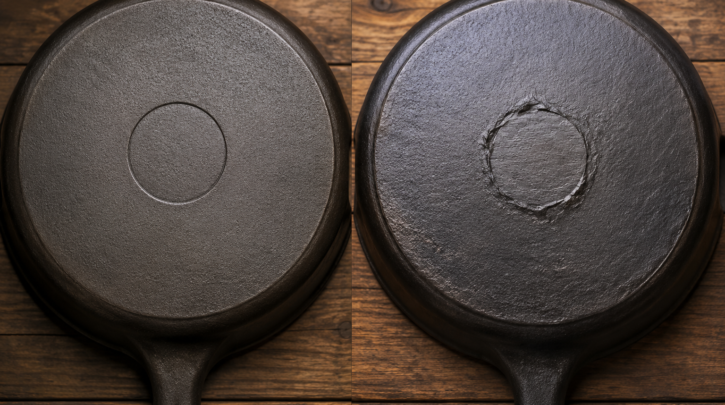
Modern manufacturing tends toward more uniform precision than the more variable traditional sand-casting processes used historically, which means unusually consistent weight or a notably different surface graininess compared to documented genuine examples is worth treating as a supporting red flag alongside other checks.
Cross-Referencing Numbers and Marks
Where size numbers, pattern numbers, and mark era all appear on a single piece, confirming that the specific combination actually matches documented genuine production catches many fakes and reproductions that get individual details right but the overall combination wrong; see our Griswold skillet numbers guide for how this cross-referencing works in detail.
Practice the Core Checks
Our free checklist walks through these exact detection principles in a format built to actually use while you’re standing over a pan at an estate sale.
Reproductions Aren’t Inherently Bad
A reproduction piece, honestly represented as such, can still be a genuinely nice piece of cookware to actually use — the real problem is only ever paying original-piece prices for one without realizing what it actually is, or later reselling one as an authentic antique.
When the Stakes Are High Enough
For any purchase where the price assumes genuine, rare authenticity, getting a second opinion from an experienced collector or a professional appraisal before committing is worth the extra effort; see our appraisal guide for how that process works across every maker on this site.
Building a Personal Reference Library
Photographing verified genuine marks, gate mark locations, and casting textures you’ve handled — either your own pieces or ones examined at shows and shops — builds a personal reference that becomes genuinely useful whenever a new piece raises a question, no matter which maker it claims to be.
Trusting the Process as You Learn
It’s completely normal to feel uncertain early on, especially given how convincing some reproductions have become — that uncertainty fades with repeated practice examining genuine pieces, and even experienced collectors occasionally get surprised, which is simply part of collecting in a hobby with real money at stake rather than a sign anything is wrong with your approach.
Staying curious and careful in roughly equal measure is the whole philosophy behind every guide on this site, and it serves you just as well here as anywhere else.
That balance is really what separates a confident, experienced buyer from someone still learning the ropes.
A Final Sanity Check
Before any purchase where authenticity genuinely affects the price, pausing to ask whether every individual check — mark, gate mark, weight, numbers — points the same direction, rather than accepting one convincing detail as proof on its own, is the single habit most likely to save you from an expensive mistake.