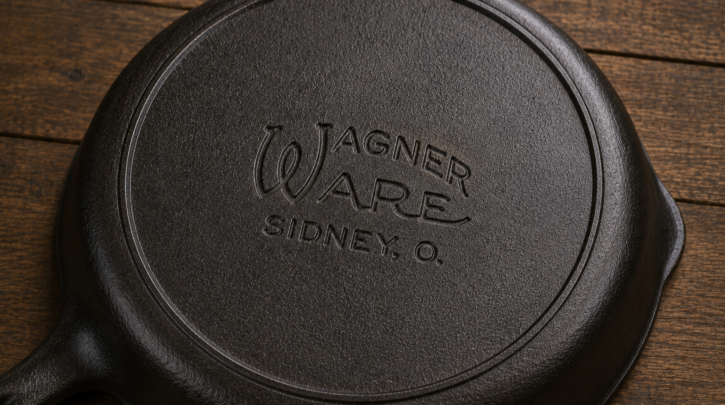

Wagner Manufacturing, based in Sidney, Ohio, was Griswold’s closest and most direct historic competitor, producing a comparably broad range of American cast iron cookware under the “Wagner Ware” brand name for decades. Identifying genuine Wagner follows the same core framework as Griswold, adapted to Wagner’s own specific marks and production history.
Wagner’s History in Brief
Founded in Sidney, Ohio in the 1890s, Wagner Manufacturing grew into one of the two dominant names in American cast iron cookware, producing skillets, Dutch ovens, griddles, waffle irons, muffin and cornbread pans, and tea kettles aimed at the same everyday household market Griswold competed for; see our Griswold vs. Wagner guide for how the two companies’ histories became connected later on.
Start With the Marks
Genuine Wagner pieces typically carry a “Wagner Ware” mark cast into the bottom, often paired with “Sidney, Ohio” or a similar hometown reference, and the exact style of this mark changed across the company’s production history; see our marks and history guide for how that evolution generally played out.
The Sidney -0- Mark
One specific Wagner mark variant, generally referred to by collectors as the “Sidney -0-” mark for its distinctive dash-O-dash stylization, is particularly well documented and especially sought after; see our Sidney -0- guide for what makes this specific mark era so collected.
Size Numbers
Like Griswold, Wagner used a size numbering system on most skillets, generally running across a similar range, though the exact diameter associated with a given number doesn’t always match Griswold’s own numbering precisely — worth checking actual measurements rather than assuming the two brands’ numbers are directly interchangeable.
Casting Quality
Wagner built a genuine reputation for smooth, well-finished castings, and some cooks and collectors consider certain Wagner production eras comparable to or even smoother than equivalent Griswold pieces — a point of genuine, ongoing friendly debate within the hobby rather than a settled fact either way.
The Same Core Checks Apply Here
Our free 5-Second Griswold Skillet ID Checklist covers general authentication principles — casting quality, mark depth, weight — that transfer directly to evaluating Wagner pieces too.
Fakes and Reproductions Happen Here Too
While Griswold draws the most counterfeiting attention in the hobby, Wagner isn’t immune — the same general detection principles apply: cast-in marks show smooth, integrated depth, while added-after marks typically show tool marks or inconsistent texture; see our general reproduction guide for the full detection framework that applies across every maker on this site.
Building Wagner-Specific Knowledge
Because Wagner has a smaller, if genuinely dedicated, collector community compared to Griswold, tracking down Wagner-specific reference material takes a bit more effort, but the underlying identification skills transfer directly; see our general antique cast iron identification guide for the broader framework that applies across every maker covered on this site.
Where Wagner Turns Up Today
Estate sales, inherited kitchen collections, and antique malls remain the most common sources for genuine Wagner, and because it was such widely used everyday cookware, it shows up in general household circulation about as often as Griswold does, even though it draws somewhat less collector attention overall; see our buying guide for what to expect across different sourcing options.
A Practical Entry Point
Starting with common mid-range Wagner sizes in clearly readable “Wagner Ware” marks builds a genuine feel for the brand’s casting quality before tackling harder identification questions like distinguishing a true Sidney -0- mark from a later, more generic one, or recognizing the various eras Wagner’s branding moved through over its long production history.
Cooking Performance Matters Alongside Collecting
Beyond any collector value question, a well-seasoned genuine Wagner skillet remains a genuinely excellent piece of cooking equipment — which is part of why so much vintage Wagner is still in active kitchen rotation rather than sitting purely as a display piece; see our seasoning guide for getting a newly acquired piece cooking-ready.
A Complementary Collection to Griswold
Many collectors who start with Griswold eventually add Wagner to their focus specifically because the two brands’ histories are so intertwined — understanding one genuinely deepens understanding of the other, and pieces from both often turn up together in the same estate sales and inherited kitchen collections.
Learning both brands together, rather than treating them as entirely separate hobbies, reflects how the actual antique market tends to present them.
It’s a genuinely natural pairing rather than an artificial one imposed by this guide.