
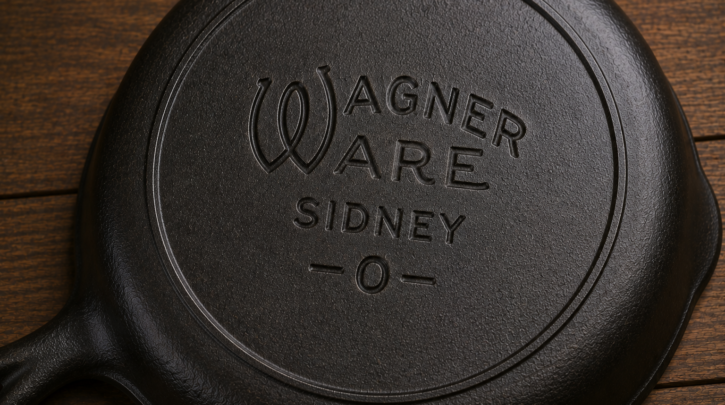

Among the many Wagner marks collectors track, “Sidney -0-” — named for its distinctive dash-O-dash stylization following the company’s Ohio hometown — stands out as one of the most specifically documented and actively sought variants in the entire Wagner lineup.
What the Mark Looks Like
The Sidney -0- mark pairs “Wagner Ware” lettering with “Sidney” and a stylized “-0-” character treatment beneath it, a distinctive enough design that experienced collectors can typically recognize it at a glance once they’ve seen a few genuine examples.
Why This Specific Mark Draws Collector Attention
Part of the appeal is simply that it’s well documented and specifically named within the hobby, which makes it an easy, concrete thing for a collector to search for and pursue — unlike some vaguer “early Wagner” descriptions, “Sidney -0-” gives buyers and sellers a shared, specific reference point that reduces ambiguity in a listing or conversation.
Confirming a Genuine Sidney -0- Mark
The same authentication principles that apply across every maker on this site apply here specifically: a genuine mark was cast directly into the piece as part of the original mold, showing smooth, consistent depth that integrates naturally with the surrounding casting texture; see our marks and history guide for the broader Wagner mark timeline this specific variant sits within.
How Fakes of This Mark Show Themselves
Precisely because Sidney -0- pieces command a real premium, they’re a genuine target for the same kind of fake or added marks that plague Griswold — watch for inconsistent lettering depth, visible tool marks, or a casting texture around the mark that doesn’t quite match the rest of the piece; see our general reproduction guide for the fuller detection framework.
Value Premium
Confirmed genuine Sidney -0- pieces generally command a meaningful premium over more generic later Wagner marks, reflecting both the mark’s documented desirability among collectors and its association with a particular respected production period; see our Wagner value guide for how this fits into the broader Wagner value picture.
Don’t Overlook the Rest of the Piece
A genuine Sidney -0- mark is a strong positive sign, but overall condition, size rarity, and form still matter just as much as they do for any other piece — a common size in poor condition, even with a desirable mark, won’t command the same price as a rare size in excellent condition bearing the same mark.
A Good Focus for a Wagner Collector
For anyone specifically drawn to collecting Wagner, learning to recognize the Sidney -0- mark on sight, and understanding roughly why it’s valued the way it is, is a genuinely worthwhile early investment of time before branching into the rest of Wagner’s broader, less individually documented mark history.
Comparing Sidney -0- Across Different Forms
The Sidney -0- mark appears across multiple Wagner product types beyond just skillets, including Dutch ovens and griddles, and collector interest in the mark generally holds across these different forms rather than being limited to any single product category.
Building Confidence Recognizing This Mark
As with any specific authentication detail, handling several confirmed genuine Sidney -0- pieces — at a show, through a collector club, or via a trusted dealer — builds a far more reliable visual memory for the mark’s exact proportions and depth than studying photos alone ever can.
A Rewarding Detail to Master
Of everything covered across this site’s Wagner guides, learning to spot a genuine Sidney -0- mark confidently is probably the single highest-value skill for someone focused specifically on this brand, given how directly it connects to both authentication confidence and real price premiums.
It’s a small, specific piece of knowledge that pays disproportionate dividends the moment you’re standing over an unfamiliar Wagner pan trying to decide whether it’s worth a closer look.
How Sidney -0- Fits Into a Broader Purchase Decision
When comparing two similar Wagner pieces where only one shows a confirmed genuine Sidney -0- mark, that mark alone is often reason enough to prefer the marked piece at a modest premium — but if the marked piece shows meaningfully worse condition than the unmarked one, condition should generally still win out, since a damaged rare mark is worth less than a pristine common one in most collectors’ eyes.
Weighing mark, size, and condition together, rather than fixating on any single factor, consistently produces the best purchase decisions.