
Lodge Manufacturing occupies a genuinely different place in vintage cast iron collecting than Griswold or Wagner — founded in South Pittsburg, Tennessee in 1896 by Joseph Lodge, it remains family-owned and in continuous production to this day, which makes “vintage Lodge” a real dating question rather than a given.
Why Lodge Collecting Works Differently
Griswold and Wagner both stopped their original production decades ago, so every genuine piece from either brand is inherently old. Lodge never stopped — it’s been making cast iron cookware continuously for well over a century, which means figuring out whether a specific piece counts as genuinely vintage requires actually comparing it against known older production markers rather than simply trusting the brand name on the bottom.
Early History and a Factory Fire
Lodge’s early history includes a factory fire that the company rebuilt from, a formative event in its history that’s still referenced in the brand’s own telling of its story today. The company’s continuous family ownership through more than a century of American manufacturing history, surviving the same economic pressures that ended Griswold’s and complicated Wagner’s, is itself a notable part of what makes Lodge collecting genuinely interesting.
Raw Cast vs. Factory Pre-Seasoned
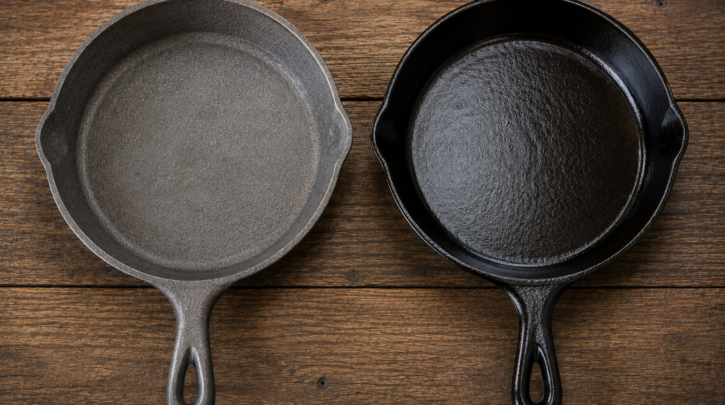
One of the most useful practical dating clues for vintage Lodge is seasoning history: older pieces were sold as raw, unseasoned castings that the buyer seasoned themselves at home, while at some point in its history Lodge shifted to pre-seasoning cookware at the factory before it ever reached a store shelf; see our dating guide for how this distinction helps place a piece in its approximate era.
The Heat Ring Detail
Some vintage Lodge pieces show a distinctive notched heat ring — small marks or notches along the ring on the underside of the pan — that collectors reference as a general era indicator, distinct from the smoother heat rings found on more recent production.
Fakes Are a Smaller Concern Here
Because vintage Lodge generally doesn’t command anywhere near the premium that genuine Griswold does, it simply isn’t a major target for the kind of deliberate counterfeiting that plagues Griswold specifically — a genuine practical relief for Lodge collectors, even though the general reproduction awareness that applies across every maker still matters; see our general reproduction guide for that broader context.
The Core Authentication Skills Still Apply
Our free 5-Second Griswold Skillet ID Checklist covers general casting-quality and mark-reading principles that carry over to evaluating any vintage cast iron, Lodge included.
A Genuinely Different Value Proposition
Because Lodge remained in continuous production, most vintage Lodge trades at more modest prices than comparable Griswold or Wagner pieces, though genuinely early and discontinued specialty forms still carry real collector interest; see our value guide and discontinued patterns guide for where that value actually concentrates.
A Good Fit for Practical Collectors
For anyone who wants genuinely old American cast iron that’s also affordable and easy to authenticate with real confidence, vintage Lodge is a reasonable, often underrated place to focus collecting energy, especially compared to the higher stakes and higher fake-risk involved in serious Griswold collecting.
Where Vintage Lodge Turns Up Today
Estate sales, inherited kitchen collections, and antique malls remain the most common sources, and because Lodge cookware was made continuously in huge volumes for everyday household use, older pieces show up in general circulation regularly rather than being a rare, hard-to-find category; see our buying guide for what to expect across different sourcing options.
Cooking Value Alongside Collecting
Whatever its age, a well-seasoned Lodge skillet is a genuinely excellent piece of cooking equipment — part of why so much vintage Lodge stays in active kitchen rotation rather than sitting purely as a display piece; see our seasoning guide for getting a newly acquired piece cooking-ready.
A Different Kind of Collecting Satisfaction
Where Griswold collecting often rewards chasing rare sizes and confirmed early marks at real cost, Lodge collecting rewards patient comparative study and offers more affordable entry into holding a piece of continuous American manufacturing history spanning well over a century.
Both approaches are legitimate ways to enjoy this hobby — the choice comes down to what kind of collecting experience appeals to you more, and either way, that history is worth appreciating on its own terms, price premium or not.