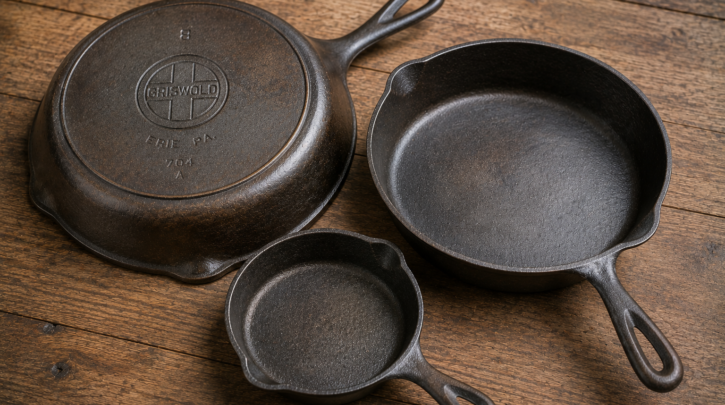

Whether you’re holding a Griswold, a Wagner, a vintage Lodge, or an unmarked orphan pan, the same core factors determine value — rarity, maker recognition, mark era, and condition — even though the specific weight each factor carries differs considerably between brands.
Maker Recognition Sets the Baseline
Griswold generally commands the strongest average prices of the three major makers on this site, reflecting its larger collector base and more extensively documented reference material; Wagner trades somewhat below Griswold despite comparable quality in many eras; and vintage Lodge trades lower still, since Lodge’s continuous production never created the same scarcity dynamic; see our Griswold vs. Wagner guide and Lodge value guide for how each comparison plays out in more detail.
Rarity of Size and Form
Within any maker, the smallest and largest sizes, along with unusual specialty forms beyond standard skillets, were produced in far smaller numbers than common household sizes, and that scarcity drives stronger prices consistently across every brand; see our rare skillets guide for specific well-known examples of this pattern.
Mark Era and Documentation
Confirmed early mark eras generally command some premium across every maker, though the exact eras considered most desirable and the size of that premium vary by brand and shift somewhat with collector trends over time; see our Griswold marks guide and Wagner Sidney -0- guide for two detailed examples of mark-driven value.
Attribution Matters
A confidently attributed piece from a recognized maker generally commands more than a comparable unmarked orphan pan, even when the actual casting quality is similar; see our unmarked cast iron guide for why attribution carries this much weight in collector pricing.
Condition Above All
A smooth cooking surface free of cracks and significant pitting matters more than almost any other single factor — cracks in particular are often a deal-breaker even on an otherwise rare and desirable piece, since they compromise both cooking function and long-term structural integrity.
Original Condition vs. Over-Restoration
Collectors generally place a real premium on pieces in good original condition over ones aggressively sandblasted or wire-wheeled, since heavy restoration removes fine casting detail and thins the metal, reducing both cooking performance and collector value; see our restoration mistakes guide for how to avoid this specific problem.
Checking Current Prices
As with every collectible category, checking recent completed sales gives a far more accurate current picture than an older printed price guide, since collector demand and pricing shift over time.
Check current vintage cast iron listings and completed sales Search vintage cast iron on eBay
When to Get a Professional Opinion
For a piece that seems like it could be genuinely rare — an unusual size, a confirmed early mark, a specialty form — a professional appraisal is worth the cost before selling or insuring it; see our appraisal guide for how that process works.
Value Beyond Resale
Knowing a realistic value matters even without any plan to sell — for insurance purposes, for deciding how carefully to store and handle a piece, and simply for understanding what’s actually in a family collection passed down without any record of what it’s worth.
A Grounded Way to Assess a Collection
For anyone assessing a group of pieces for the first time, start by identifying maker, size, and mark era for each piece, note visible condition issues, then check recent completed sale prices for comparable pieces before assuming either that everything is worthless or that every piece is a hidden fortune — the reality for most collections sits somewhere in between.
Rarity Isn’t the Only Reason to Value a Piece
A common, modestly valued skillet that’s been in a family for generations, used for countless meals, carries a different kind of worth than a strictly financial appraisal captures — sentimental and practical value are genuinely legitimate reasons to keep a piece regardless of what a price guide says it’s worth on the open market.
Documenting a Collection Over Time
Keeping photos and notes on each piece’s maker, size, mark era, and condition, alongside whatever price research you’ve done, creates a useful running record whether you eventually sell, insure, or simply want to track how a collection has grown.
That balanced approach protects against both under-selling a genuine rarity and over-insuring a box of common pieces.