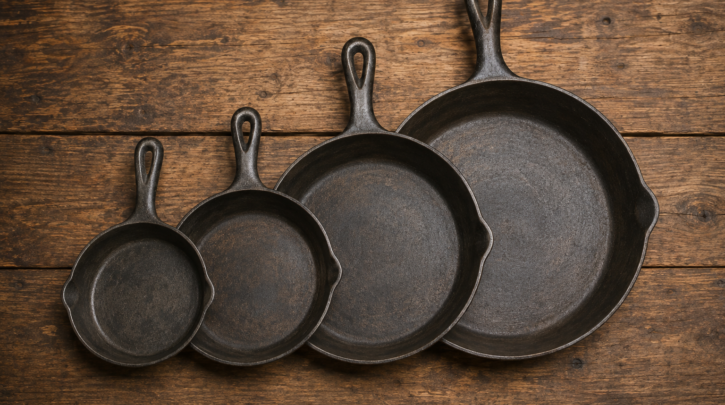

Most vintage American cast iron uses a size number system roughly corresponding to diameter, but the exact measurement tied to a given number isn’t perfectly consistent across every maker — worth knowing before assuming a number means exactly the same thing regardless of brand.
The General Size Number Concept
Across Griswold, Wagner, and Lodge, larger size numbers generally correspond to larger skillets, with the most common household sizes falling in the middle of each brand’s range; see our Griswold skillet numbers guide for the most extensively documented version of this system.
An Approximate Cross-Brand Reference
| Size Number | Approximate Diameter | Note |
|---|---|---|
| 3 | ~6.5 inches | Small, less common size |
| 5 | ~8 inches | Popular smaller everyday size |
| 6 | ~9 inches | Common household size |
| 8 | ~10.5 inches | One of the most common sizes overall |
| 9 | ~11.25 inches | Common household size |
| 10 | ~11.75 inches | Common household size |
| 12 | ~13.5 inches | Larger, less common size |
These figures are general, commonly cited approximations rather than exact specifications for every maker and era — always confirm precise measurements against the actual piece rather than relying on a size number alone when precision matters.
Why Numbers Don’t Perfectly Match Across Brands
Griswold and Wagner both used broadly similar numbering concepts, but the exact diameter tied to a specific number doesn’t always match precisely between the two brands; see our Wagner identification guide for how Wagner’s own numbering compares to Griswold’s.
Modern Lodge Sizing
Because Lodge remains in continuous production, current Lodge cookware uses its own modern sizing conventions, which may or may not align cleanly with vintage size numbers from the same or other brands; see our vintage Lodge guide for how Lodge’s continuous operation affects this kind of comparison generally.
Using This Chart Practically
This chart works best as a rough starting reference for picturing roughly how large an unfamiliar size number is, not as a precise conversion tool — when exact size matters, such as confirming a piece fits an existing set or a specific stovetop burner, measuring the actual piece remains the only fully reliable method.
Sizes and Value
As covered in our value guide, the smallest and largest sizes across every maker generally command stronger prices than the common mid-range sizes, since they were produced in smaller numbers; see our value guide for how size rarity fits into the broader value picture.
Matching Pans to Cooking Needs
Beyond collecting value, size matters enormously for everyday cooking — a size 8 works well for two to three servings of most stovetop dishes, while a size 10 or 12 suits larger batches or bigger cuts of meat, which is worth keeping in mind when deciding which sizes to prioritize for a working kitchen collection rather than pure display.
Measuring a Piece Yourself
Measuring across the widest interior point of a pan, rather than the outer rim, gives the most useful practical diameter figure for comparing against recipes or existing cookware — a small habit that avoids confusion when a size number alone doesn’t quite match expectations.
Sizes Beyond Skillets
Dutch ovens, griddles, and other hollowware forms use their own size conventions that don’t map directly onto the skillet numbering system covered here — a Dutch oven’s size is typically expressed differently, often tied to capacity or a separate numbering scheme specific to that form, so this skillet-focused chart shouldn’t be assumed to apply universally across every product type.
Why Rare Sizes Are Rare in the First Place
The smallest and largest sizes across every maker were simply less useful for typical household cooking than the common mid-range sizes, which meant lower original demand and lower production volume — a straightforward economic reason behind a rarity pattern that shows up consistently across Griswold, Wagner, and other makers alike.
Understanding that economic logic makes the whole rarity pattern feel far less arbitrary once you know where it comes from.