
The single biggest difference between a listing that sells well and one that lingers isn’t the photos, the price, or even the condition — it’s whether the seller can name the mark. “Old skillet, some rust” and “Griswold large block logo, No. 8, smooth bottom” describe pieces that could be identical in every other respect, but they’ll pull very different offers, because one of them tells a buyer exactly what they’re looking at and the other asks them to guess.
For a mid-tier piece — not a museum-grade rarity, not a cracked reject, just a solid, common Griswold or Wagner — the mark era usually moves the price more than condition alone does. That makes identification the actual first step of selling, not an afterthought you fold into the listing description. This guide walks through why, and how to build the rest of your listing around it.
Identify Before You List — Not While You List
Confirming maker, size, mark era, and approximate age comes first, before you photograph, price, or write a word of description. A piece mispriced because it was misidentified helps no one — it either sells for less than it’s worth, or it sits unsold indefinitely at a price nobody who actually knows the mark would pay. See our general identification guide for the framework that applies across every maker covered on this site.
For Griswold specifically, the mark sequence is well documented enough that you can date a piece to a fairly narrow window just by matching the logo style:
- Erie / slant mark: An early lettered mark tied to the company’s Erie, Pennsylvania origins, used before the block logo became standard.
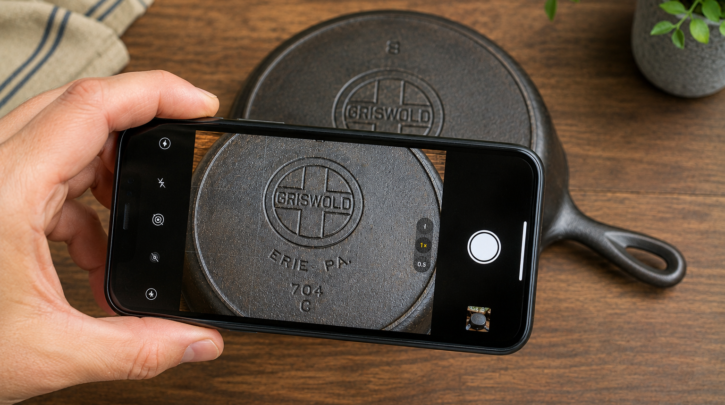
- Large block logo: The bold block-letter “Griswold” logo from the company’s peak production decades — the most commonly found mark on mid-tier pieces.
- Heat ring vs. smooth bottom: A raised ring on the underside points to an earlier production run built for older stoves; a smooth bottom points to later manufacturing aimed at modern ranges.
Our Griswold marks and logos guide has the full visual reference, and our heat ring guide covers that distinction in more depth. If the piece isn’t marked at all, our unmarked cast iron identification guide covers the shape and casting cues to work from instead.
Why the Mark Outsells Condition for a Mid-Tier Piece
Condition matters, but it mostly adjusts price within an era — it doesn’t set the baseline the way the mark does. A buyer scanning listings for a specific mark era will pay a real premium for a piece that’s clearly identified over one that isn’t, even when the actual physical condition is comparable, because “I know exactly what this is” is worth something on its own. A listing that just says “old skillet” forces every serious buyer to either pass entirely or lowball the offer to cover the risk of not knowing what they’re actually buying.
That’s the practical payoff of identifying before you list: naming and dating the mark in your listing title and description is very likely to get you a meaningfully better offer than a vague description of the same piece, condition held equal.
Clean Gently Before Photographing
A gentle clean before listing genuinely helps a piece show well in photos, but resist the urge to attempt any deeper restoration right before a sale — inexpert restoration can reduce value more than the original condition issue did, and can obscure exactly the mark detail you need visible for identification. See our restoration mistakes guide for the specific errors worth avoiding.
Photography That Proves the Identification
Once you know the mark, your photos need to prove it. Clear, well-lit shots of the mark itself, any size or pattern numbers, the gate mark if present, and the overall cooking surface give serious buyers the specific details they’re actually looking for — not just a single generic overview shot. Collectors buying online rely heavily on these detail photos since they can’t handle the piece before purchasing, and a sharp photo of the logo is what lets a knowledgeable buyer confirm your identification themselves rather than take your word for it.
Honest Condition Disclosure
Disclose cracks, significant pitting, warping, or prior repairs clearly and specifically, rather than using vague language or hoping a buyer won’t notice. This protects your reputation as a seller and avoids disputes after a sale — serious collectors specifically appreciate sellers who describe condition precisely, on top of already appreciating a seller who’s correctly identified the mark.
Pricing Against Real Sales — For That Specific Mark Era
Check recent completed and sold listings for your identified mark era specifically, not just what other sellers are currently asking for something described more loosely as “vintage cast iron.” Asking prices are aspirational and often considerably higher than what buyers actually pay, and pricing against sales of the wrong era — because the piece wasn’t correctly identified first — is one of the most common ways sellers underprice or overprice a mid-tier piece. See our value guide and the maker-specific value guides across this site for the factors that drive price in each category.
Search current listings and completed sales for vintage cast iron on eBay to see what comparable, correctly identified pieces are actually going for.
Choosing Where to Sell
A common, widely available piece often does best on a general marketplace with the largest possible buyer pool, while a rare or pattern-specific piece can sometimes do better through a specialist channel with a more targeted collector audience. See our buying guide for the flip side of this same landscape from a buyer’s perspective, which applies just as well when deciding where to list.
Shipping Heavy Cast Iron Safely
Cast iron is durable but can still crack if dropped or poorly packed, and its real weight adds a genuine shipping-cost consideration that lighter collectibles don’t share. Wrap the piece well, use a sturdy box with minimal empty space for it to shift around in, and factor accurate weight into shipping price calculations before finalizing a listing price.
When a Piece Warrants Extra Care
If your mark identification points to something beyond mid-tier — an unusual size, a specialty form, a confirmed early mark era — a professional appraisal before setting a price is worth the cost, since guessing wrong in either direction on a genuinely valuable piece has real consequences. See our appraisal guide for how that process works and when it’s actually warranted.
Writing a Listing That Builds Trust
A detailed, specific listing — exact maker, size number, mark era, precise measurements, and an honest condition description — consistently outperforms a vague one. Serious collectors actively search for specific makers, sizes, and mark eras, and they skip past listings that don’t clearly identify what’s actually being sold. Leading with the mark era you identified is the single highest-leverage line you can add to a title.
Being Patient With Rare Pieces
A genuinely rare size or specialty form sometimes takes longer to find the right buyer than a common piece would, simply because the pool of interested collectors is smaller. Resist the urge to drop the price prematurely on something truly scarce just because it hasn’t sold in the first week or two.
Selling a Whole Collection at Once
For someone liquidating an entire inherited or accumulated collection rather than a few individual pieces, an estate sale company or a dealer offering to buy the full lot outright can be more practical than listing dozens of individual items one at a time — even though the per-piece return is typically lower than patient individual sales would bring. Either approach can work well; the right choice depends on how much time and effort you want to invest in the sale itself.
The Bottom Line
Identify before you list. Name the mark era in your title and description, back it up with a sharp photo of the logo, and price against sold listings for that same era — not a vague “vintage cast iron” average. That single step, done before anything else in the selling process, is what separates a listing that gets a real offer from one that just says “old skillet” and waits.