
Most cast iron doesn’t need a paid appraisal. It needs someone to actually read the mark on the bottom. Griswold changed its logo several times between the 1870s and the 1950s, and each version was stamped during a specific, well-documented window — which means the mark on your pan is a built-in date stamp, free, before you spend a dime on a professional opinion.
The reverse is just as useful: a mark that doesn’t match its claimed age is the single biggest red flag in cast iron collecting, and it’s exactly the kind of thing worth paying an appraiser to sort out. This guide walks through how to use logo era as your first, free filter — and when to stop guessing and call a professional instead.
Start With the Mark, Not the Surface
A heavily pitted skillet with a rare early mark can still be worth far more than a smooth, well-seasoned pan from a common production run. Condition affects price within an era, but the era itself — which logo, which manufacturing period — sets the ceiling on value before condition ever enters the conversation. That’s why the mark comes first, every time, whether you’re buying at a flea market or deciding whether a family piece deserves a formal appraisal.
For a full walkthrough of what to look for on the bottom of a pan, see our guide to identifying antique cast iron.
Griswold’s Logo Evolution, in Order
Griswold changed its bottom marking several times over roughly seventy years of production, and each version corresponds to a fairly specific window. Knowing where a piece sits in that sequence is the fastest way to sanity-check any age claim.
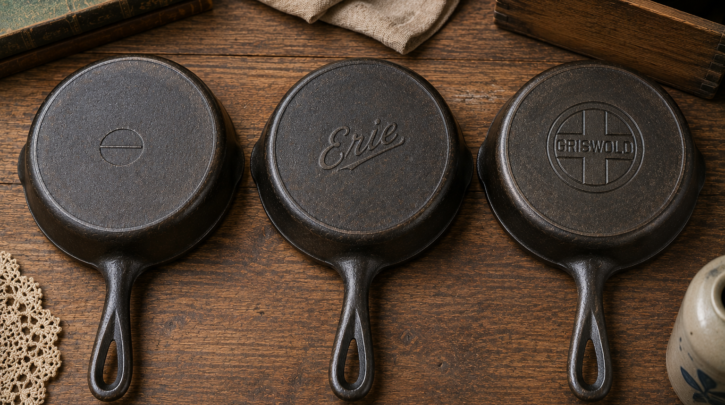
- Gate marks (pre-1890): A straight raised line across the bottom, left over from the sand-casting process, marks the oldest Griswold production still commonly found. These predate the well-known cursive and block logos entirely.
- Slant ERIE / EPU marks (roughly 1900s–1920): Early lettered marks tied to the company’s Erie, Pennsylvania origins, used before the block logo became standard.
- Large Block logo (1920s–1930s): The bold block-letter “Griswold” logo most people picture, produced during the company’s peak manufacturing decades.
- Heat rings (phased out by the late 1930s): A raised ring on the underside, common on pans designed for older wood- and coal-burning stoves. Their disappearance tracks the shift toward smooth-bottom pans built for the flatter surfaces of modern ranges.
For the complete visual reference — photos of each logo variant side by side — see our Griswold marks and logos guide. If you’re starting from a completely unmarked piece, our unmarked cast iron identification guide covers the shape and casting cues to look for instead.
The Red Flag: When the Mark Doesn’t Match the Story
Here’s the part that actually matters for your wallet: a marked piece whose logo era contradicts its claimed age is a red flag, full stop. A pan sold as a “rare 1870s Griswold” but stamped with a large block logo can’t be from the 1870s — the block logo didn’t exist yet. A “pre-1900 heat ring skillet” bearing a mark style associated with the 1920s has the same problem in reverse.
This kind of mismatch shows up in a few recurring ways:
- A seller’s description assigns a decade that predates the logo actually stamped on the piece.
- A mark looks slightly off in spacing, depth, or letterform compared to confirmed examples of that era.
- A pattern or size number appears in a combination that doesn’t match documented production records for that mark style.
None of that is something you need to resolve alone. It’s exactly the situation where a paid appraisal earns its cost — see the next section for when that step makes sense. For a deeper look at how reproductions and altered marks show up in practice, our Griswold fakes and reproductions guide and antique vs. modern reproduction guide go into more detail.
Use Mark Identification as Your Free First Pass
Before spending money on anyone’s opinion, work through this yourself:
- Photograph the bottom of the piece in good light, straight on.
- Identify the logo style — gate mark, slant ERIE/EPU, large block, or a later variant — against reference photos.
- Check for a heat ring and note whether it’s present or absent, which narrows the window further.
- Record the pattern number and size number stamped near the logo.
- Compare the claimed age or price against what that specific mark era actually supports.
Our heat ring guide and size chart are both useful references for steps three and four. If the piece checks out — the mark, the era, and the claimed history all line up — you likely have enough to make a confident buying or selling decision without paying anyone. Our cast iron value guide and rare skillets guide can help you gauge a reasonable price range from there.
When to Reserve a Paid Appraisal
A formal appraisal earns its cost in three situations specifically:
- Suspected added or altered marks. If the logo era, spacing, or depth looks inconsistent with confirmed examples, or if a mark appears to have been added to an otherwise unmarked piece, that’s an authentication question a professional is equipped to answer.
- Rare pattern numbers. Unusual sizes, uncommon patterns, or pieces like spider skillets that fall outside routine production deserve professional confirmation before a major sale or insurance decision.
- Insurance or estate documentation. Insuring a valuable collection or settling an estate among multiple heirs requires a documented, professional valuation — a personal read of the mark, however accurate, isn’t sufficient on its own for either purpose.
Outside of those three cases, an informal opinion from an experienced dealer or collector is usually enough for everyday buying and selling decisions.
Finding a Qualified Appraiser
Look specifically for an appraiser experienced with antique cookware or cast iron rather than a general antiques generalist. Check for credentials from a recognized professional body — the International Society of Appraisers, the Appraisers Association of America, and the American Society of Appraisers are all established organizations that certify appraisers to recognized professional standards, and most offer searchable member directories.
A Red Flag on the Appraiser Side, Too
Reputable appraisers charge a flat fee or an hourly rate — never a percentage of the appraised value. A percentage-based fee creates a direct financial incentive to inflate the valuation, which professional appraisal standards treat as an ethical conflict of interest. An appraiser offering to work for a cut of the final number is worth avoiding regardless of how reasonable the rest of the pitch sounds.
Preparing for an Appraisal
Clean pieces gently beforehand so the appraiser can clearly see marks, numbers, and casting detail without dust or grime in the way — but skip any deeper restoration attempt right before an appraisal. See our restoration mistakes guide for why that timing matters; an aggressive strip-and-reseason job right before authentication can remove or obscure exactly the detail an appraiser needs to see.
Bring your own mark identification notes along with any known provenance or family history, and come with specific questions written down. Current value, insurance replacement value, and authenticity are often different questions with different answers, and being clear about which one you need helps the appraiser focus the assessment.
Appraisal vs. Authentication
It’s worth distinguishing between the two. An appraisal estimates monetary value; authentication confirms a piece is genuinely what it’s claimed to be. A thorough appraiser typically does both together, but for a piece where the mark-era mismatch is the actual concern — rather than value specifically — say so upfront.
Cost Expectations and What Happens After
Formal appraisal fees vary with the appraiser’s experience, location, and the complexity of the piece, but a reasonable flat or hourly fee for a focused cast iron appraisal is typically a small fraction of the value being assessed — for anything genuinely worth the trouble of a formal appraisal in the first place.
Keep the completed appraisal document with your insurance records, and plan to revisit a formal appraisal every several years for a genuinely valuable collection, since both the market and the collection itself can change. Treat it as a well-informed snapshot rather than a permanent, unchanging figure.
The Bottom Line
Read the mark first. Gate mark, slant ERIE/EPU, large block logo, heat ring present or absent — that sequence tells you more about what a piece is actually worth than its surface condition ever will, and it costs nothing but a few minutes with a reference photo. Save the paid appraisal for the cases that actually need it: a mark that doesn’t add up, a genuinely rare pattern number, or paperwork for insurance and estate purposes.